

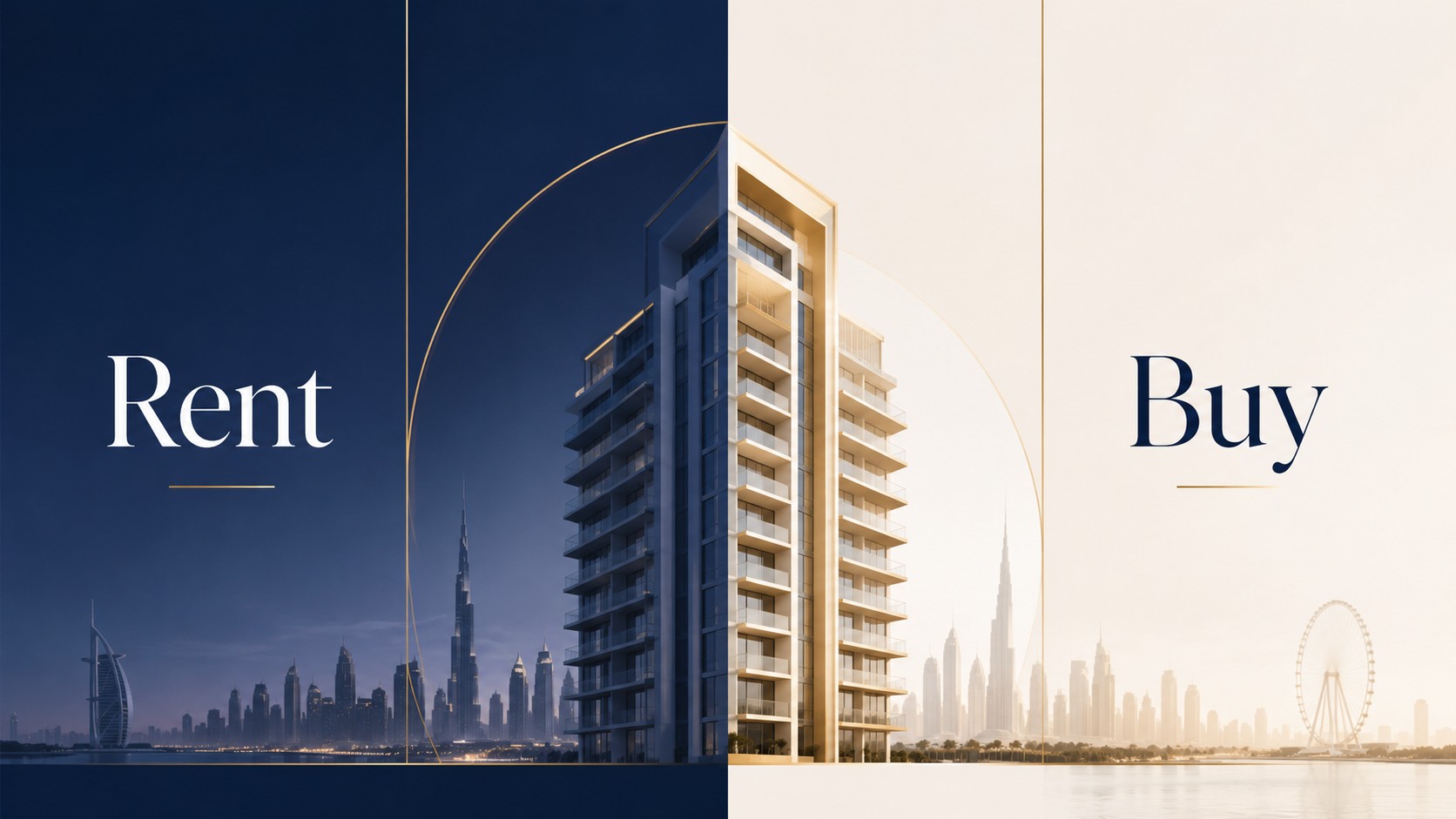
At What Point Does Renting Stop Making Sense in Dubai?
Renting can be smart. Buying can be smart. The expensive mistake is assuming one is always better.
In Dubai, the rent vs buy decision depends less on what people say at dinner and more on your numbers, your timeline, your cash position, and how long you expect to stay.
If you are renewing your lease, looking at rising rents, or wondering whether your monthly rent could become a mortgage payment, the question is not simply "Can I buy?"
The better question is:
"Will buying make sense for my life, cash position, and likely holding period?"
The problem with comparing rent to mortgage payments
Many Dubai renters make the comparison too simply.
They look at their annual rent, divide it by 12, then compare it with a possible mortgage payment.
For example, if you pay AED 120,000 per year in rent, that is AED 10,000 per month. If a mortgage calculator shows a similar monthly payment, buying can look obvious.
But that is only part of the picture.
Buying property in Dubai usually requires significant upfront cash. You may need a deposit, transfer fees, agency commission, trustee fees, valuation fees, mortgage-related charges, conveyancing, moving costs, and a post-completion buffer.
Those costs change the calculation.
A mortgage payment might be close to your rent, but the full buying decision is bigger than the monthly number.
The practical rent vs buy framework
Use four questions before deciding whether buying makes sense.
1. How long do you expect to stay?
Your time horizon matters because buying has upfront costs.
If you buy and sell too quickly, the transaction costs can outweigh the benefit of owning, even if the monthly mortgage payment looks manageable.
A short stay often favours renting. A longer stay may make buying more realistic, especially if the alternative is paying high rent year after year.
2. How much cash do you actually have?
Deposit money is not the same as buying money.
For a Dubai purchase, you need to think about the full cash required to complete the transaction. This may include:
- Deposit or down payment
- Dubai Land Department fees
- Agency commission, where applicable
- Trustee and registration fees
- Mortgage valuation and lender-related costs
- Moving, furnishing, maintenance, and cash buffer
All figures should be treated as indicative. Confirm current fees and your own position with a qualified adviser, lender, conveyancer, or relevant professional before committing.
3. What is your monthly comfort zone?
A bank may approve a mortgage amount, but that does not mean it is sensible for your household.
Your monthly comfort zone should account for:
- Mortgage payment
- Service charges
- Insurance where applicable
- Utilities and maintenance
- School fees, car payments, childcare, and other fixed costs
- Emergency savings
The aim is not to buy the most expensive property possible. The aim is to buy without making your monthly life fragile.
4. What are you giving up by using the cash?
Buying ties up cash.
If you use AED 350,000 to AED 500,000 to buy, that money is no longer sitting freely in your account. It is now part of the property purchase.
That may be fine. It may even be the right decision. But it should be a conscious choice, not a side effect of getting tired of renting.
A simple Dubai example: renting vs buying over 3 years
Here is an indicative example.
A Dubai resident is renting for AED 120,000 per year. They are considering buying a property for AED 1,500,000.
Their rough comparison might look like this:
- Annual rent: AED 120,000
- Three years of rent: AED 360,000
- Example property price: AED 1,500,000
- Example 20% deposit: AED 300,000
- Indicative upfront buying costs: potentially AED 90,000 to AED 130,000 or more, depending on the transaction
At first glance, spending AED 360,000 on rent over three years feels painful.
But buying is not automatically better over a three-year period. If the buyer pays substantial upfront costs, then sells after only three years, they need enough property value growth, equity gain, or lifestyle benefit to justify those costs.
There is also selling risk. Market value may rise, remain flat, or fall. Selling also takes time and may involve further costs.
For a three-year horizon, buying can work, but the numbers need to be tested carefully.
A simple Dubai example: renting vs buying over 5 years
Now extend the same example to five years.
- Annual rent: AED 120,000
- Five years of rent: AED 600,000
- Potential rent increases: possible, depending on the property, location, and market conditions
- Ownership period: long enough for upfront costs to matter less per year
Over five years, buying may become more attractive because the upfront costs are spread across a longer period.
The buyer may also build some equity through repayments, depending on the mortgage structure. They may gain more control over their home, avoid annual rent negotiations, and reduce uncertainty around lease renewal.
But buying still needs to be tested against cash flow, service charges, maintenance, mortgage rates, and exit assumptions.
The point is not that five years always means buy. The point is that the longer your expected holding period, the more seriously buying deserves to be modelled.
Common mistake: buying because rent feels wasted
"Rent is dead money" is too simplistic.
Rent buys flexibility. It lets you move areas, change property size, leave the UAE more easily, and avoid ownership risk.
That flexibility has value.
Buying can build long-term value, but it also brings commitment, costs, maintenance, market exposure, and less flexibility.
The mistake is not renting. The mistake is renting or buying without calculating the trade-off properly.
When renting may still make sense
Renting may be the better option if:
- You may leave Dubai within one to three years
- Your job, visa, school, or family plans are uncertain
- You do not yet have enough cash for deposit and fees
- You would have no emergency buffer after buying
- You are still testing areas, communities, or commute patterns
- You are only considering buying because rent has increased
In these cases, renting can be a strategic choice rather than a failure to buy.
When buying may start to make sense
Buying may be worth serious consideration if:
- You expect to stay in Dubai for several years
- You have enough cash for deposit, fees, and a buffer
- Your monthly mortgage payment would sit within a comfortable range
- You understand the service charges and ownership costs
- You are buying for practical use, not just emotion
- You have compared the numbers against your current rent
Buying can make sense when it gives you stability, fits your budget, and matches your likely timeline.
What to do before renewing your lease
Before you renew, negotiate, or start viewing properties, run a simple comparison.
Work out:
- Your current annual rent
- Your expected rent over the next three to five years
- The type of property you would realistically buy
- The likely deposit needed
- The estimated upfront buying costs
- The monthly mortgage payment at cautious rates
- The ownership costs, including service charges and maintenance
- Your likely holding period
You can use the QuickProperty mortgage calculator to estimate monthly payments, then compare that against your rent and wider costs.
Use conservative numbers. A decision that only works with perfect assumptions is not a strong decision.
The practical rule
If you expect to stay briefly, need flexibility, or would empty your savings to buy, renting may still be sensible.
If you expect to stay longer, have enough cash, and can buy without stretching your monthly life, buying may deserve a proper calculation.
The answer is not emotional. It is not universal. It is personal to your numbers.
Run your own numbers before renewing
Before your next lease renewal, check whether buying is genuinely realistic.
Use the QuickProperty budget checker to estimate your buying budget, upfront cash requirement, and monthly affordability. Then compare that against your current rent, likely renewal cost, and how long you expect to stay in Dubai.
It will not replace advice from a qualified professional, lender, broker, or conveyancer, but it can help you avoid guessing your way into a major financial decision.
FAQ 1: Is it better to rent or buy in Dubai?
It depends on your cash position, monthly affordability, expected time in Dubai, and the property you would buy. Renting can suit short or uncertain timelines, while buying may make more sense over a longer period.
FAQ 2: When does buying become better than renting in Dubai?
Buying often becomes more worth considering when you expect to stay for several years, have enough cash for deposit and fees, and can manage the monthly mortgage comfortably.
FAQ 3: Should I compare rent directly with mortgage payments?
No. A mortgage payment is only one part of the buying cost. You should also factor in deposit, DLD fees, agency commission, service charges, maintenance, and a cash buffer.
FAQ 4: Is rent wasted money in Dubai?
Not necessarily. Rent gives flexibility, lower commitment, and easier mobility. Buying can build ownership, but it also brings upfront costs, ongoing costs, and market risk.
FAQ 5: What should I calculate before renewing my Dubai lease?
Compare your annual rent, likely renewal cost, deposit requirement, upfront buying fees, monthly mortgage payment, ownership costs, and expected holding period.
Check the numbers before you renew
Renting may still be right. Buying may now be realistic. The only useful answer is the one based on your actual figures.
Use the QuickProperty budget checker to estimate your UAE buying budget, upfront cash requirement, and monthly affordability before your next lease decision.