

Paying Down the Mortgage Faster Can Still Leave You Financially Exposed
If you are weighing mortgage overpayment against keeping cash in hand, the right answer is not just about saving interest. For Dubai property buyers, especially expats and overseas buyers, the real question is whether paying extra into the loan leaves enough money for Dubai property buying costs, service charges, emergency spending and the next few months of life.
The short answer
Mortgage overpayment can make sense if the loan interest saved is worthwhile and the lender does not charge heavy early-repayment fees. Keeping a cash buffer can make more sense if your savings are thin, your income is variable, or you expect near-term costs such as moving, furnishing, visa changes, school fees or a lease renewal.
The useful comparison is not just interest saved versus interest paid. It is interest saved, plus fees avoided or paid, versus how much cash you still have after the overpayment. If an overpayment leaves you with a very small reserve, the benefit can be weaker than it looks on paper.
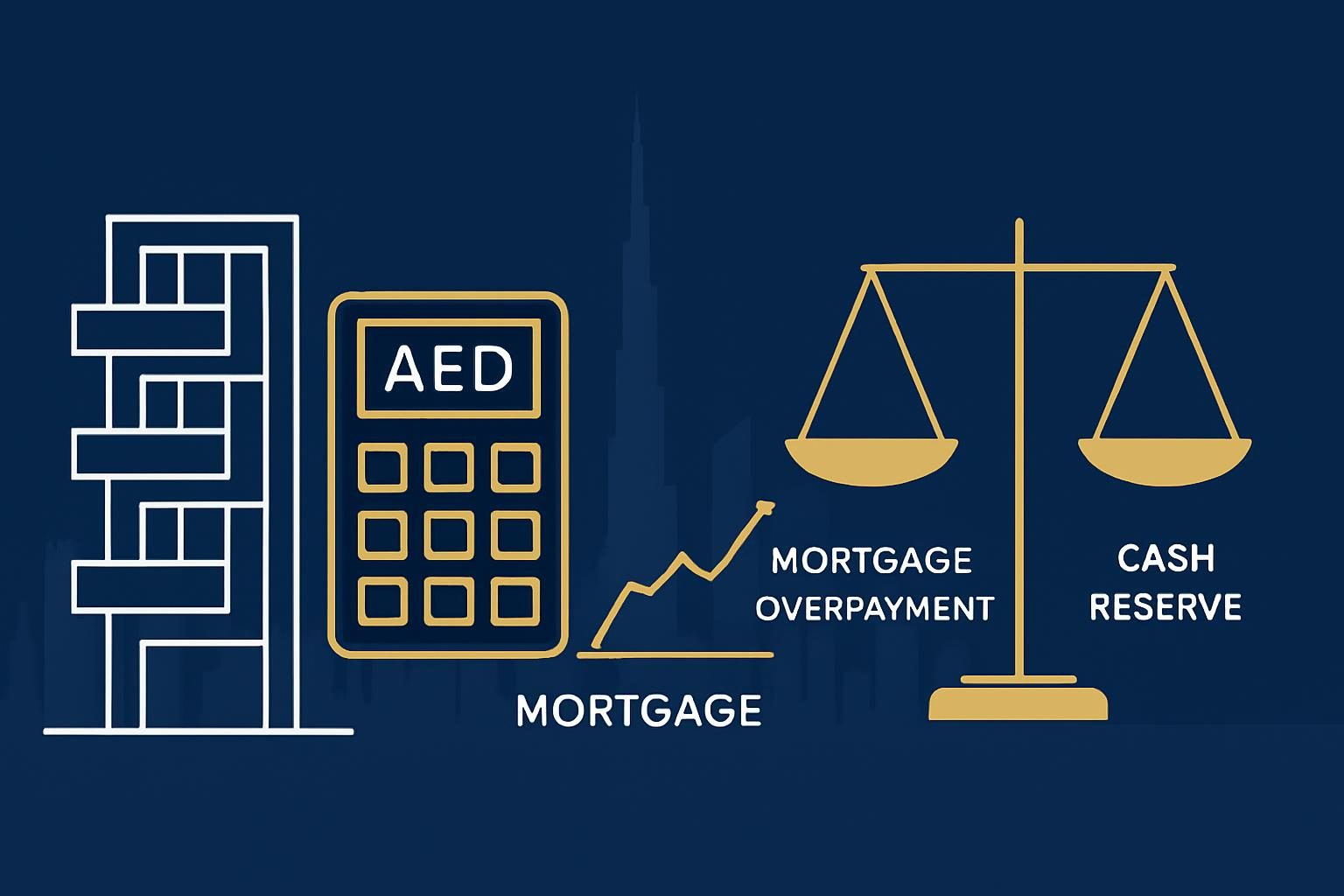
Mortgage overpayment versus cash buffer is a trade-off between reducing debt faster and keeping liquidity. In Dubai, that means comparing interest saved on the mortgage against early-repayment fees, service charges, maintenance, moving costs and a realistic emergency reserve before you commit.
Why this matters for Dubai buyers
A lot of buyers focus on the loan balance and forget the rest of the bill. That is risky in the UAE because completed residential purchases usually come with a deposit, Dubai Land Department transfer fees, agency commission where applicable, valuation fees, mortgage registration fees and other upfront buying costs that can add up quickly.
If you pour every spare dirham into the mortgage, you may be left with too little to handle a job change, family expense, vacancy period, repair bill or a few months of higher living costs. That is especially relevant for expat buyers whose income may be tied to one employer, one currency, or one rental cycle.
A practical way to compare the two options
- Estimate your spare cash after the purchase and after all near-term costs.
- Check the lender’s rules on partial overpayment and early-repayment charges.
- Estimate how much interest the overpayment would save over the time you plan to stay in the property.
- Decide how much cash you need to keep available for emergencies and planned spending.
- Compare the remaining cash in each scenario, not only the mortgage balance.
That final step is where many buyers make the wrong call. A smaller loan is useful, but only if it does not leave you dependent on credit cards, forced selling, or borrowing back what you just paid off.
Assumptions used
The example below is illustrative only. It excludes salary changes, rental income, tax effects, investment returns on spare cash and any lender-specific conditions beyond a simple early-repayment charge assumption. It also excludes service charges and maintenance unless stated separately.
Assumptions: a Dubai mortgage with an outstanding balance of AED 900,000, an indicative interest rate of 4.5% per year, and a partial overpayment of AED 100,000. A simple early-repayment charge of 1% applies on the overpaid amount, so AED 1,000 in fees. The comparison looks at a 12-month horizon for simplicity.
Illustrative comparison: overpay now or keep the cash?
| Scenario | Mortgage balance after action | Cash left after action | Indicative interest effect over 12 months | Notes |
|---|---|---|---|---|
| Overpay AED 100,000 | AED 800,000 | AED 0 from that pot | Saves roughly AED 4,500 in interest before fees | Less AED 1,000 early-repayment fee, so net benefit is around AED 3,500 |
| Keep AED 100,000 in cash | AED 900,000 | AED 100,000 | No interest saved | Cash remains available for emergencies, moving, repairs or short-term gaps |
In this simplified model, the overpayment saves about AED 4,500 in one year because 4.5% of AED 100,000 is roughly AED 4,500. After an AED 1,000 fee, the net saving is about AED 3,500. That can be a sensible trade if your reserve is already healthy. It is a weaker trade if that AED 100,000 is your only liquidity buffer.
Now look at the cash side. If you keep the AED 100,000 instead, you have no interest saving, but you retain access to money that could cover a few months of expenses. For a Dubai buyer, that might be more valuable than a modest interest saving if the next 6 to 12 months include furniture, agency renewals, school fees, travel, or a buffer against variable income.
A UAE-specific way to think about the buffer
For many UAE households, a practical reserve is not just one mortgage payment. It is often closer to several months of essential outgoings, plus expected property costs. That could include mortgage repayments, service charges, utilities, insurance, transport and everyday living costs. The exact figure depends on your income stability and family commitments.
If you are an overseas buyer or an expat with one main salary, the buffer matters even more. A lower mortgage balance is useful, but it does not help much if you have to cover a job gap or a move before your next salary arrives.
Who this applies to
- Dubai homeowners deciding whether to overpay a completed property mortgage
- Expats comparing debt reduction with liquidity
- Overseas buyers who may face currency conversion costs or irregular cash flow
- Buyers who have already covered deposit and upfront buying costs but still have spare savings
Who this does not apply to
- Buyers with no emergency fund at all
- Anyone with lender restrictions or high early-repayment charges that make overpayment inefficient
- Off-plan buyers whose payment schedule is driven by the developer plan rather than a standard mortgage
- Cash buyers deciding between property and an investment portfolio, which is a different question
Common mistake: treating all spare cash as mortgage money
The common mistake is overpaying first and thinking about liquidity later. That can look tidy on a spreadsheet, but it ignores real-life timing. A broken appliance, job change, medical bill, family trip or lease expense does not wait for the mortgage to feel smaller.
Another mistake is ignoring the lender’s fee structure. If early-repayment charges are high, the math can change quickly. A small interest saving is not always enough to justify locking up cash and paying fees to do it.
What to do next
- Work out your current savings after deposit and Dubai property buying costs.
- Separate emergency cash from money you could genuinely overpay.
- Check your mortgage terms for partial overpayment limits and fees.
- Compare the interest saved with the value of keeping cash available.
- Run the numbers before speaking to an agent, broker or lender.
If your main concern is what money you still need after buying, use the QuickProperty budget checker to test your buying budget against deposit, fees and spare cash. If you want a repayment estimate for a specific loan, the QuickProperty mortgage calculator is the better fit. You can also compare the QuickProperty tools if you are still deciding which step comes first.
Frequently asked questions
Is it better to overpay a Dubai mortgage or keep cash?
There is no single answer. Overpaying can reduce interest and shorten the loan, but keeping cash can protect you against job changes, repairs, moving costs and higher living expenses. The better option depends on your emergency reserve, lender fees, income stability and how soon you may need the money.
How much cash should I keep after buying Dubai property?
There is no fixed rule, but many buyers aim to keep enough for several months of essential expenses, plus property costs such as service charges and maintenance. If your income is variable or tied to one employer, a larger reserve is usually more practical than directing every spare dirham to the mortgage.
Do Dubai mortgage overpayments always save money?
No. They save interest only if the rate, balance, time horizon and lender fees stack up in your favour. If the early-repayment charge is high, or if you would otherwise need to borrow later at a worse rate, the net result may be weaker than expected.
Does keeping cash instead of overpaying help with Dubai property buying costs?
Yes. Cash can be used for service charges, furnishing, moving, agency-related expenses, repairs and short-term gaps after purchase. That matters because Dubai property buying costs do not end with the deposit. If your savings are limited, liquidity can be more useful than a small interest saving.
Should an expat buyer in Dubai prioritise mortgage overpayment?
Not automatically. Expat buyers often face relocation costs, currency transfers, school fees and income risk that make liquidity important. If overpaying would leave too little cash for the next six to twelve months, keeping the buffer may be the safer practical choice.
Before you decide, compare the cash left afterwards, not only the interest saved. If you want a clearer view of whether your savings stack up against Dubai property buying costs, try the budget checker and see how much room you actually have after the purchase.