

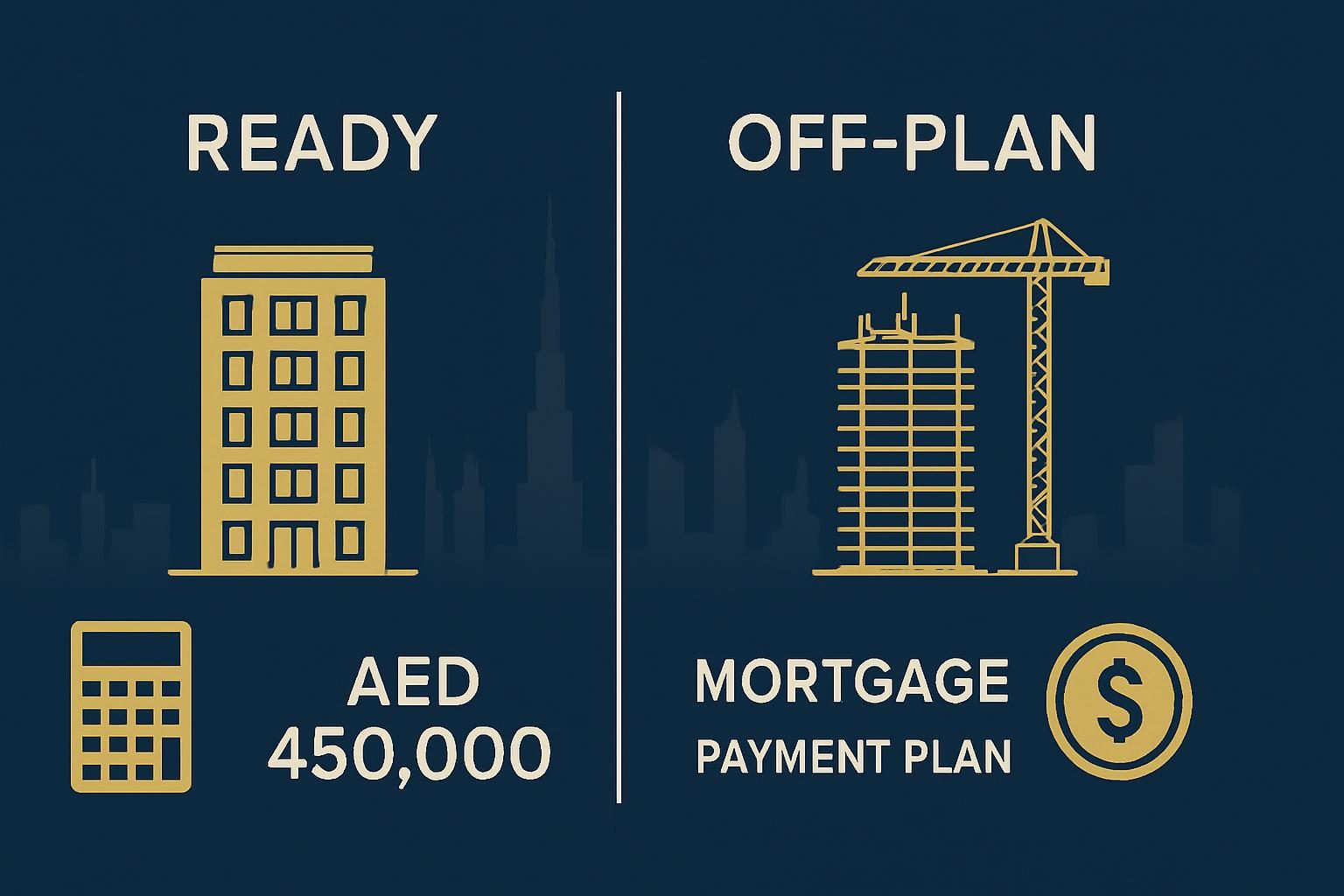
Ready property or off-plan? The cheaper-looking option is not always safer.
If you are comparing Dubai property, the headline price can be misleading. A ready apartment may need a bigger deposit and heavier upfront costs, while off-plan can look cheaper at first but bring staged payments, handover risk and tighter cash flow. For expat buyers, overseas buyers and investors, the real question is not just price. It is whether the purchase fits your mortgage timing, savings and monthly budget.
The short answer
Ready property usually gives you more certainty. You can see the unit, estimate the mortgage sooner and model the monthly cost with fewer unknowns. Off-plan can spread payments, but the plan can still strain cash flow if the developer schedule, handover date or final mortgage stage does not line up with your savings.
For most buyers, the better option is the one that leaves enough room for deposit, Dubai Land Department fees, agency commission, service charges and a cash buffer after completion or handover. If you are stretching to cover the first payment, the cheaper-looking route is often the riskier one.
Ready property suits buyers who want certainty on timing, costs and monthly repayments. Off-plan suits buyers who can handle staged payments, possible delays and a longer wait before they can use or rent the property. The right choice depends on cash flow, not just the listed price.
Why the price tag can be deceptive
A ready home and an off-plan home can both sit inside the same budget on paper, but they behave very differently in real life.
- Ready property: bigger amount due upfront, then mortgage payments begin soon after transfer.
- Off-plan: smaller initial outlay in some cases, but regular construction-linked payments may continue for years.
- Ready property: lower timing risk, but you need enough cash to complete the purchase quickly.
- Off-plan: lower entry price can hide the final handover cost if you still need a mortgage later.
The common mistake is comparing only the asking price. Buyers should compare the full cash required, the timing of each payment, and what happens if the mortgage, income or savings do not line up when expected.
Assumptions used
The comparison below is indicative only and uses rounded figures for a Dubai residential purchase. It assumes a buyer is purchasing a property worth AED 1,200,000. For the ready purchase, it assumes a 20% deposit, around 4% DLD fee, around 2% agency commission and a small allowance for other buying costs. For the off-plan example, it assumes a developer plan with a 20% booking payment, 40% staged during construction, and 40% due on handover, with some transaction costs still payable along the way. Mortgage terms, lender criteria, service charges and developer schedules can change the outcome.
Side-by-side comparison: ready purchase versus off-plan plan
| Cost item | Ready property | Off-plan property |
|---|---|---|
| Headline price | AED 1,200,000 | AED 1,200,000 |
| Initial payment | AED 240,000 deposit | AED 240,000 booking payment |
| DLD fee | About AED 48,000 | Often payable during the purchase process, around AED 48,000 |
| Agency commission | About AED 24,000 | May be lower or not applicable depending on structure, but assume some buying costs |
| Other upfront costs | Allow about AED 10,000 to AED 20,000 | Allow about AED 10,000 to AED 20,000 |
| Construction or mortgage timing | Mortgage starts soon after transfer | Staged payments before handover, mortgage may start later |
| Cash pressure point | Immediately after purchase | At handover if a mortgage is needed for the final 40% |
On a ready purchase, the buyer might need roughly AED 322,000 to AED 332,000 before keys change hands, depending on exact fees and lender requirements. On the off-plan example, the first payment may look lighter at AED 240,000, but the buyer still needs to be ready for the next stages, and potentially a large handover bill.
What the cash flow pressure looks like in practice
Now compare how the money actually moves.
With ready property, the upfront outlay is heavier, but after completion the buyer can usually move to a regular mortgage payment and budget around that from day one. This is easier to plan if you want a clear monthly number.
With off-plan, the pressure can be hidden. A buyer may pay 20% at booking, another 40% during construction, then face the final 40% on handover. If the property is delayed, if rental income does not start on time, or if the buyer expected to refinance but cannot, the cash gap can become the real problem.
This is why Dubai off-plan property risks are not only about the developer or the finish quality. They are also about timing, funding and whether you can still complete if plans change.
A practical decision framework
- Start with total cash available. Include deposit, DLD fee, agency fee, furnishing, moving costs and a buffer.
- Separate upfront costs from monthly costs. Ready property usually turns into mortgage repayment sooner. Off-plan may delay that, but not remove it.
- Check the payment schedule. Look at how much is due now, during construction and at handover.
- Stress test the final stage. Ask what happens if your mortgage offer is smaller than expected or delayed.
- Keep a buffer. If all your savings go into the initial payment, the purchase may be fragile.
Who this applies to
- Ready property may suit you if: you want a clearer mortgage timeline, plan to move in soon, or want to rent the unit quickly after purchase.
- Off-plan may suit you if: you have strong cash flow, can manage staged payments, and are comfortable waiting for handover.
- Neither may suit you yet if: the deposit and fees leave you with no buffer, or you are relying on future income to make the purchase work.
Common mistake: ignoring the handover bill
The biggest mistake with off-plan is assuming the small first payment is the whole story. It is not. The handover stage can demand a large lump sum, and if the mortgage is not ready, the buyer may need extra cash quickly. That is where the cheap-looking option becomes expensive in practice.
Another mistake is assuming ready property is always safer because it is finished. It may be safer on timing, but if the buyer has not budgeted for DLD fees, commission, service charges and moving costs, the purchase can still feel tight.
What to do next
Before speaking to an agent or committing to a property, run the numbers using the full budget, not just the headline price. Compare the deposit, the likely buying costs, the mortgage timing and the cash buffer you would still have left.
If you want a quick way to test whether the purchase fits your finances, use the QuickProperty budget checker. If you also want to test repayments, compare that with the QuickProperty mortgage calculator. You can also review the QuickProperty tools if you are planning a Dubai property purchase and want to compare your options properly.
Compare the full cost before choosing off-plan or ready. A lower headline price is not the same as a lower-risk purchase.
FAQs
Is off-plan property riskier than ready property in Dubai?
It can be, mainly because of payment timing, handover uncertainty and the possibility that your mortgage or cash plan does not match the final stage. Ready property has fewer timing unknowns, but it still needs careful budgeting for deposit and fees. The risk depends on your cash buffer, not the property type alone.
What are the main Dubai off-plan property risks?
The main risks are payment schedule pressure, construction or handover delays, final-stage funding gaps, and the chance that your planned mortgage does not cover what you expected at completion. Buyers should also check service charges, developer terms and whether they can still complete if their savings change.
How much cash do I need for a ready property in Dubai?
As a rough guide, expat buyers often need around 20% to 25% deposit, plus around 4% DLD fee, agency commission where applicable, and other buying costs. In many cases, upfront costs can add around 6% to 8% or more on top of the deposit. Exact figures vary by lender and transaction.
Can I buy off-plan in Dubai if I plan to use a mortgage later?
Possibly, but the final mortgage stage matters. Some buyers pay in stages during construction and then use a mortgage at handover. The key question is whether the final amount due can still be covered if the mortgage offer is lower than expected or delayed.
Should I use a budget checker or mortgage calculator first?
If your main question is whether you can afford the deposit, fees and buying costs, start with the budget checker. If you already know the purchase price and want to estimate repayments, use the mortgage calculator next. For ready versus off-plan, many buyers need both, because affordability and repayment timing both matter.